By: Emma Kirstine Aarøe and Martha Goriatcheff-Madsen
What does the future of personal transportation look like? For many years the answer to this question has been focused on self-driving cars. In the 1930’s General Motors introduced the idea of a future consisting of self-driving cars on their exhibition ‘Futurama’ (VeloceToday, 2014). In 1956 American papers published the concept of ‘electric super-highways’, where electronic devices in the road would control speed and steering, resulting in a driverless experience. In 1958 prototyping of these super-highways were initiated with successful tests, yet the concept was ultimately scrapped as it was found too expensive to implement (VeloceToday, 2014). This changed the trajectory of self-driving cars from creating ‘smart’ roads to ‘smart’ cars. Even if the circumstances to realize this future has changed through the years, some patterns have been established: this future has always revolved around a replacement of the driving component from the human to the technology.
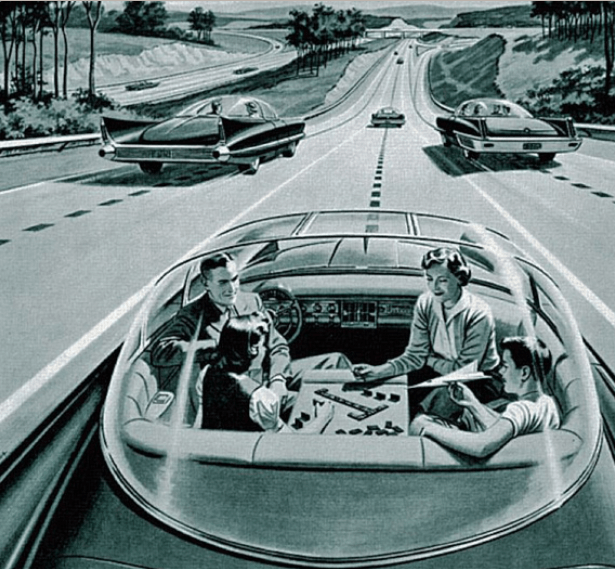
The following blogpost will discuss the translation between human and technology within the theme of driving a car. It will discuss our “nearly arrived” future of self-driving cars and the problem framing behind. One of these problem framing can be seen in a TED talk, done by Jeff Schneider (TEDxCMU, 2017). A research professor at Carnegie Mellon University, who praises the self-driving cars and the many positive side effects of these, such as fewer accidents and freeing up of time, money and space. This sounds almost too good to be true… Our underlying question is thus: is this story supporting our future reality or is the narrative supporting the perfect world of self-driving cars?
A PERFECT STORY…
Jeff Schneider begins his presentation by delivering the hot news that 35 people are going to die in car accidents worldwide during his talk (TEDxCMU, 2017 – [0.10]). This horrifying data acts as a great way to catch the attention of the audience while simultaneously creating a shared picture of driving, as a deadly and dangerous activity. He then proceeds to showcase that in 94% of the accidents the driver is at fault, with most of the accidents occurring as a result of bad decisions or a lack of attention (TEDxCMU, 2017 – [2.25]). His focus and presentation of this data provide him with the necessary evidence to paint a picture of the driver as the defective component. It is not the car that is dangerous, nor the act of driving… No, the component responsible for these deaths is the human driver.
How can this problem be fixed? Easily. As he suggests, we have to replace the defective component, the human driver, with an efficient technological component, the self-How can this problem be fixed? Easily. As he suggests, we have to replace the defective component, the human driver, with an efficient technological component, the self-driving car. He highlights that the responsibility today is attached to the human driver. Therefore a shift in responsibility from the human to the car will solve this problem and theoretically reduce accidents by 94%. By framing the problem in this way, Jeff Schneider provides a linear solution: a substitution of one entity to another one.
To sum up, this fifteen-minute talk describes the problem (the driver), the solution (self-driving cars), the creating and testing of these, and lastly the benefits of implementing them: saving time, saving money and saving space in the cities. All these extra benefits are supporting his perfect solution of self-driving cars.
The autonomous vehicles has been under way for many years, which is also presented in tThe autonomous vehicles have been under way for many years, which is also presented in the TED talk. If we take a look at the linear model of innovation processes according to Vannevar Bush it is possible to map Schneider’s presentation of self-driving cars in this – a process that only leaves room for little change and certainly no radical.
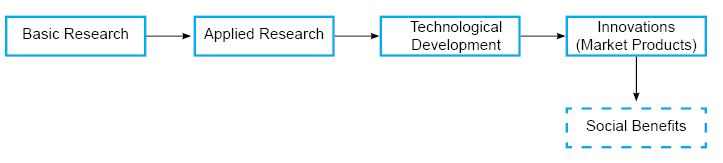
Autonomous vehicles are based upon this basic research that already exists, which we are also taken on a stroll down during the TED talk. They have then managed to go from applied research in closed, protected areas to technological development, in which the self-driving cars are actually being tested in our existing system of transportation. At the end of his talk Jeff Schneider demonstrates how to achieve the social benefits through the market product of self-driving cars, e.g. more time and greener urban spaces. Schneider’s structure thus manages to follow a very linear narrative with the description of a problem, the solution and the benefits thereof.
A PERFECT STORY… OR NOT?
So, while the chosen narrative is a very linear one, we need to warn that Schneider’s story is a personal standpoint; the paradigm of the transportation system as eSo, while the chosen narrative is a very linear one, we need to warn that Schneider’s story is a personal standpoint; the paradigm of the transportation system as experienced by him. This is the story of a transportation system with a defective component. The story of the need for a shift in responsibility. However, this story, this way of framing the problem excludes several important points as e.g. the socio-technical components which are actually deeply embedded in his narrative. As smith reminds, “Seven dimensions have been suggested for characterizing the socio-technical: (1) guiding principles; (2) technologies and infrastructures; (3) industrial structure; (4) user relations and markets; (5) policy and regulations; (6) the knowledge base for the regime; and (7) cultural, symbolic meanings underpinning practices.13 Ultimately, it is diverse actors who reproduce these regimes.” (Smith, p429, 2017).
First and foremost, the benefits listed by Schneider as a result of implementing self-driving cars excludes a better explanation of their achievement. If we consider the time parameter, he says that the average American, annually, uses 42 hours in traffic jams and 293 hours driving. Time we will regain if people don’t have to own or drive themselves (TEDxCMU, 2017 – [11.45]). In this narration, it is first unclear how many of these ‘recovered’ hours will be spent in a self-driving car. Meanwhile we don’t know what we are actually allowed to do, while ‘driving’ in these cars. What will be the regulation? Will we be legally obliged to be aware of the traffic and ready to take control of the car ? We will then not gain extra time. Freeing up space within cities is also relying upon extra systems/services such as a sharing service. An implementation of self-driving cars without this will still be as space consuming as seen today, and thus still require huge amounts of space for parking. Another benefit mentioned by Schneider is the possible drop in prices of goods, when transportation thereof will become autonomous and therefore cheaper. This benefit will rarely, if ever, fit into a sustainable system, as it is widely known that a drop in price may increase consumption, thereby resulting in a so called rebound effect (Allwood, et.al., 2011)
Secondly, the exclusions of issues provide a perfect narrative for Jeff Schneider; the self-driving cars as a solution fixes the problem of human failure, however, this kind of failure isn’t exclusively happening within the car. Distracted pedestrians, cyclists or kids all raise a terrible dilemma. What will happen if a child runs out in front of a self-driving car? Should the car be programmed to keep going or should it be programmed to tolerate this human mistake?
These ethical dilemmas are not discussed nor mentioned in the talk. Jeff Schneider doesn’t explain how to build a new technological responsibility based on ethical human choices.

A NEED FOR HUMAN INTERACTION
Self-driving cars are introduced into an established system designed for other products, in which, e.g. the easy access from sidewalks and cyclists’ lanes could lead to many ethical dilemmas as mentioned above. Since it consists of several mixed mobilities; cars, buses, cyclists, pedestrians, etc. different mobilities have to cohabit and exist concurrently at the same place. According to Schot and Geels, we need to be aware that technology pushes the exclusion of other actors: ”Technology actors such as firms and governments introducing new technologies tend to exclude certain actors and focus on optimising the technological side first while neglecting other social aspects.” (Schot & Geels, 2008-p544).
In this case, we risk the optimisation and further development of the autonomous vehicles will overshadow other aspects. It’s already noticeable during Schneider’s TED talk;
“But first I wanna describe the problem to you”, with this sentence he plays a point-of-view shot taken from a car driving on a regular american street. In this he points to several problems; cars that don’t signal, pedestrians crossing the roads outside the crosswalks, bicycles going in random directions, flashing lights from advertising, signs unrelated to traffic, etc. (TEDxCMU, 2017 – [5.56]). But the funny thing here is, he only links these problems together with the programming of the self-driving car. This is a perfect example of the technology being granted prioritization. These problems all point to a faulty infrastructure that also exists as problems with a human driver, but instead of dealing with these issues, focus is on the development of self-driving cars, and the adaptation to the existing transportation system.
We have discussed how self-driving cars could face difficulties by being pushed directly into thWe have discussed how self-driving cars could face difficulties by being pushed directly into this existing environment and interact with the other actors – even Schneider himself identifies these as mentioned above. However, in Schneider’s story the transportation environment doesn’t seem to change radically to fit with the new product. Instead, he gets around the problem, by programming the product to fit into the existing system. However, according to Adrian Smith, radical changes are necessary in order to achieve a sustainable production and consumption system (Smith, 2007). Therefore, we suggest that the base for a new narrative should consider that the existing system is designed both for and from mobility of human interaction.
DISASSEMBLE FOR REASSEMBLE – ACTIVATE AWARENESS FOR HUMAN EMPATHY
So, why is Schneider’s story trying to cut the responsibility of the human driver through self-driving cars when this responsibility could indeed have a positive impact towards human interaction?
A new narrative for reimagining a “more” sustainable paradigm towards the transportation system should engage actors toward key challenges and key benefits: how human awareness could lead to positive human interaction and give better human empathy and sustainable results?
An experience in Paris was made to rethink the qualification of safety and the cause of the accidents in the road (Mairie de Paris, 2018). The question driving this experience was how to re-evaluate the relevance of existing components within the transportation system. Some specific elements are still persistent over time and the traffic lights were one of the key components deeply embedded in the safety system of cities. The experience decided to focus on this component to unlock the routine of the transportation system and start to ask new questions:
- When could a transition occur in order to mitigate the number of accidents and the traffic jam in the city center?
- How far can we say that traffic lights are mandatory elements in the transportation system?
- How far can we qualify traffic lights as a key value to build and maximize security in our crowded cities?
Traffic lights started to be interrupted at a few crossroads where the speed was limited at 30km/h (figure 1). After eight months of experience, the statistics showed a diminution of accidents in these experimental sectors and a diminution of the pollution in these areas during the period of the experience.
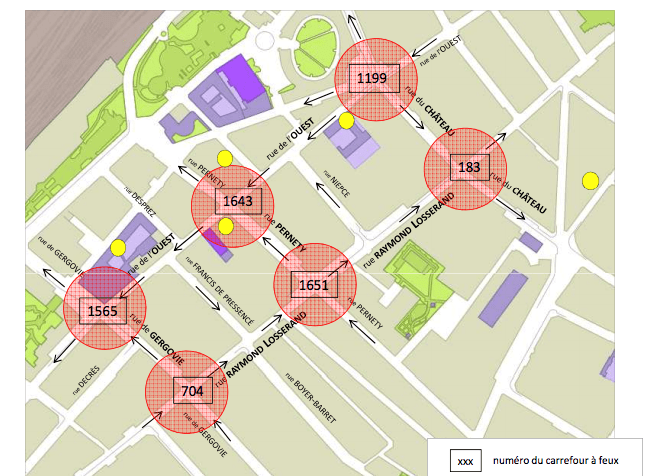
Ref: Mairie de Paris (2018). Présentation BILAN – réunion publique 17 sept 2018.
In a first stage, shutting down the traffic lights has firstly requalified the transport system as a hostile environment; a jungle. In this context, the driver takes new responsibility looking at the other actors interacting at the same time without any technological guidance.
The second stage is when the transition can start to occur, the beginning of new insight: empathy driving the decision between the different actors. The driver is making more effort to re-align its interest with other interests, e.g. the pedestrian who has waited a long time to cross the street, or the bus that has difficulties to drive in the narrowed streets of Paris. This new empathic human decision has led to better results according to the Paris city hall: more awareness, more interaction with all the actors, more empathy, less accidents, less noise and less pollution due to a more fluent traffic (Mairie de Paris, 2018).
Another experience occurs to complete our new sustainable empathic transportation paradigm. Unpredictable situations can lead to new habits and sustainable change. An example of this was during the strike with the transportation system in Paris in 2019. Since the strike lasted surprisingly longer than others one, several months from the 13th of September 2019 to the end of january 2020, the citizens and workers had to change their routines. With no public transportation available and terrible car traffic, the users of cars and the public transportation had to quickly translate themself as a new group of cyclists.
Even if the design of Parisian roads is not adapted to this new amount of cyclists, people enjoy it and keep cycling after the end of the strike. It encourages the mayor and other political actors to redesign new wide bike lanes and thus apply sustainable change (Reid, 2020).
This new paradigm can show how the transition can occur by removing stabilized components of a regime, and not only by implementing new features. It also shows how human interaction is precious. Within the transportation environment, human interactions have been a source of reflection for established rules and new rules, creativity, inspiration and design. Heritage of urban politics have translated their physical environment and made it unique: the combination of different generations, models and culture. For example, when the twentieth Century is claiming the separation of the urban functions, the twenty-first Century tries to raise the mix of mobility and the reduction of CO2 emission. Human interaction is a precious source for new reflection.
CONCLUSION À LA CALLON
First, this conclusion places emphasis on Callon’s work: framing is always excluding (Callon, 1998). Callon highlights the need of destabilizing established frames which are sources of lock-in. Jeff Schneider’s scenario is built as a justification of a new technological product, a self-driving car, to solve human failure and accidents in the transportation system. It is not a reality but his reality. Second, from Geels’ transition perspective, it is even a dangerous frame because the solution narrative shifts from a human problem to a technological problem and removes all the social aspects attached to the existent context. The technology forced into an existing infrastructure needs to require a strong knowledge of all the socio-technical components constituting this environment. We know that sustainable behavior can be acknowledged and improved by reaching human responsibility. Subsequently, the frame based on technology as a solution thus needs to be destabilized and reframed to be based on human empathy. If, like Jeff Schneider proposes, we remove human interaction by implementing self-driving cars, the technology will need to be further developed through a machine learning process with quantities of situations and human decisions accumulated. And we are not there with Jeff Schneider’s story. The human is the most precious and complex component of the transportation system and we need to reopen a debate around human responsibility. Driving a car without a traffic light will be a good start to reframe the human responsibility and acknowledge all the uncertainties. Taking the imperfection of human driver’s decisions as a norm and reaching new positive insight: with time reaching this human awareness and empathy will hopefully lead to a stabilized situation for a better sustainable context in the transportation system
REFERENCES
Allwood, J. M., Ashby, M. F., Gutowski, T. G., & Worrell, E. (2011). Material efficiency: A white paper. Resources, Conservation and Recycling, 55(3), 362-381.
Callon, M. (1998). An essay on framing and overflowing: economic externalities revisited by sociology. The Sociological Review, 46(1_suppl), 244-269.
Geels, F. W. (2002). Technological transitions as evolutionary reconfiguration processes: a multi-level perspective and a case-study. Research policy, 31(8-9), 1257-1274.
Geels, F. W. (2012). A socio-technical analysis of low-carbon transitions: introducing the multi-level perspective into transport studies. Journal of transport geography, 24, 471-482.
Mairie de Paris (2018). Présentation BILAN – réunion publique 17 sept 2018. [online] Available at: https://www.mairie14.paris.fr/actualites/experimentation-de-carrefours-sans-feux-le-point-sur-les-mesures-d-accompagnement-453 [Accessed February 13. 2020].
Reid, C., (2020). Every Street In Paris To Be Cycle-Friendly By 2024, Promises Mayor. [online] Available at: https://www.forbes.com/sites/carltonreid/2020/01/21/phasing-out-cars-key-to-paris-mayors-plans-for-15-minute-city/#5e1b2cf66952 [Accessed February 13. 2020].
Smith, A. (2007). Translating sustainabilities between green niches and socio-technical regimes. Technology analysis & strategic management, 19(4), 427-450.
Schot, J., & Geels, F. W. (2008). Strategic niche management and sustainable innovation journeys: theory, findings, research agenda, and policy. Technology analysis & strategic management, 20(5), 537-554.
TEDxCMU (2017). How Self-Driving Cars Will Transform Our Cities and Our Lives. Available at: https://www.youtube.com/watch?v=CHV4AiCvSmw [Accessed February 13. 2020].
The Local France, (2020). A strike effect? Parisians stay on their bikes as transport goes back to normal. [online] Available at: https://www.thelocal.fr/20200204/a-strike-effect-parisians-stay-on-their-bikes-as-transport-goes-back-to-normal [Accessed February 4. 2020].
VeloceToday, (2014). Self-Drive Cars and You: A History Longer than You Think. [online] Available at: https://www.velocetoday.com/self-drive-cars-and-you-a-history-longer-than-you-think/ [Accessed February 13. 2020].
 Sustainable Transition